project-image

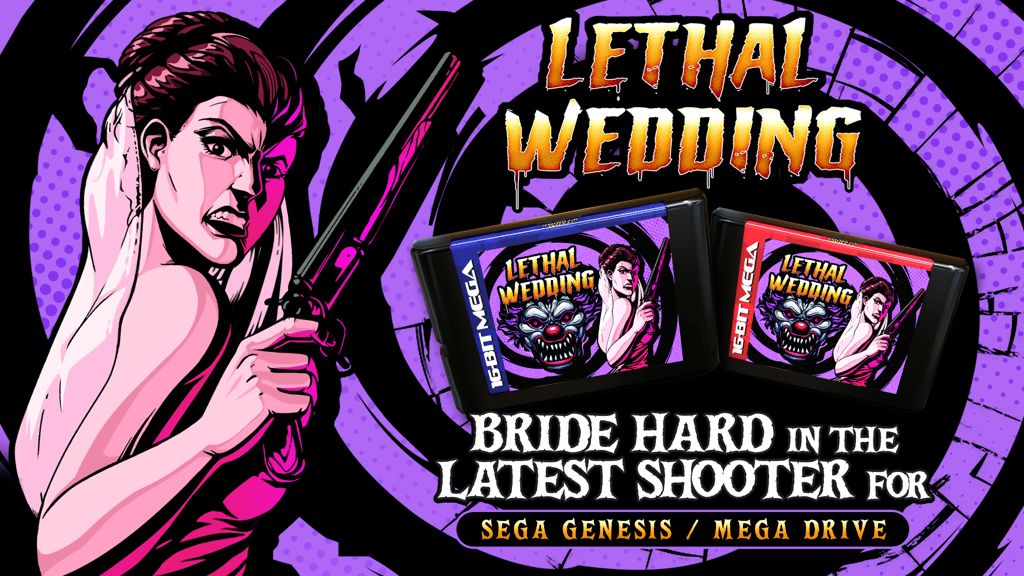
Lethal Wedding

Created by Mega Cat Studios

Say “I do” to bullets and blood in this top-down RPG shooter on Sega Genesis and Mega Drive!

Latest Updates from Our Project:

Cake is Cut, Campaign is Closed! 389% Funded!
about 2 months ago – Thu, Jul 02, 2026 at 11:33:07 AM

The final bell has rung, the reception doors are closed, and we are standing here completely blown away. The Lethal Wedding Kickstarter campaign is officially over, and you all absolutely crushed it.

Saying thank you honestly doesn't feel like enough, but from the bottom of our hearts, a massive, bloody thank you to everyone who backed the project, shared the link, or just cheered us on in the comments. You are the reason this game is coming to life on Sega Genesis/Mega Drive, and Steam.

VICTORY IS SWEET. AND A LITTLE BLOODY.

Thanks to your unbelievable support, Lethal Wedding is officially a reality. Look at what we managed to pull off together during this crazy month:

  • Funded in 90 Minutes: You completely shattered our initial goal before we even had time to process the launch day nerves.
  • 749 Backers: A full army of retro arcade fans stepped up to support this game.
  • $58,467 Total Funding: You pushed us to a massive 389% funded finish, unlocking some incredible upgrades along the way.

Look At What We Unlocked!

Because you all absolutely destroyed our funding goals, we didn't just fund the base game. We managed to clear some massive milestones together, meaning everyone gets a serious upgrade to their rewards:

  • $45K Unlocked – Bill Tiller Kickstarter Exclusive Poster & Box Art: 

LucasArts legend Bill Tiller (The Curse of Monkey Island) is officially lending his iconic art style to Lethal Wedding! Complete-in-Box backers can now opt for an exclusive alternate box art design via their BackerKit survey. 

Backers with a Limited Edition cartridge (tier or add-on) will also receive an exclusive physical poster! As a thank you, we are also adding the digital Bill Tiller poster to ALL digital and physical reward-tier bundles. No matter how you backed us, you're getting a piece of this legendary collaboration.

(Important Note: Poster is an LE bonus item and won't be sold separately). 

  • $50K Unlocked – The Fatman & Team Fat Deluxe OST CD:

The legendary duo behind the Zombies Ate My Neighbors soundtrack, George Sanger and Joe McDermott,  is officially bringing a face-melting chiptune score to the game! This unlocks a physical Deluxe OST CD add-on complete with the original soundtrack and brand-new exclusive tracks. Even better: EVERY single backer across all tiers will now automatically receive the digital Fat Adventures coloring book in their rewards bundle! 

Missed out on adding the CD during the live campaign? Don't worry, you will still have the opportunity to update your pledge and select more-add ons once the BackerKit Survey is sent out in the coming weeks.

So, What Happens Next?

Now that the live campaign is wrapped, we are moving straight out of fundraising mode and deeper into production. Here is a quick, practical roadmap of what you need to look out for over the next few weeks:

  • Check Your Payment: Kickstarter will now process all pledges. They will email you directly if there are any issues with your payment information. Please keep an eye on your inbox for any messages from them.
     
  • Wait for the Survey: After Kickstarter has finished processing everything, we will send out a survey through our pledge manager. This is where you will be able to confirm your rewards, provide your shipping address, and grab any last-minute add-ons you might have missed. Keep an eye on your email for that!
     
  • Keeping in Touch: The campaign might be over, but you won't be left in the dark. We are going to keep posting regular updates right here on Kickstarter to show you our ongoing development progress, art assets, behind-the-scenes milestones, and manufacturing steps. You're with us all the way to the finish line.

Thank you all again for an absolutely unforgettable month. Celebrate the win with us, take a breather, and we'll talk to you very soon. Time for us to head back into the dev trenches and build the best Sega Genesis game we possibly can!

-Mega Cat Studios

The Final 24 Hours! We Are 350% Funded!
about 2 months ago – Wed, Jul 01, 2026 at 09:23:09 AM

The final 24-hour countdown is officially on, and honestly, we are staring at the numbers in absolute shock. Thanks to this incredible community crashing the gates and backing the project, Lethal Wedding is officially 350% funded!

We could not have asked for a wilder, more passionate group of backers to bring this Sega Genesis dream to life. A massive, bloody thank you to every single one of you who pledged, shared, and cheered us on. You guys RULE!!!

Last Call for Exclusive Loot

With the clock ticking down fast, this is your absolute last chance to lock in your backer tier or grab those limited-edition extras. Once the timer hits zero, these Kickstarter exclusive rewards are gone for good.

From Limited Edition Sega Genesis cartridges and the killer Vinyl LP, to custom Shadowboxes, enamel pins, and bullet resin coasters, there is a ton of crazy gear up for grabs.

Plus, thanks to everyone absolutely destroying our milestones, we unlocked some massive upgrades along the way. That includes the Bill Tiller Kickstarter Exclusive Poster and Box Art at $45k and the Fatman and Team Fat Deluxe OST CD Add-On at $50k (which also adds a free digital coloring book to everyone's rewards bundle).

If you want to grab that physical CD, the vinyl, or upgrade to a complete-in-box Limited Edition Cartridge, do it right now by editing your pledge before the reception doors lock forever.

The Final Push: Let's Unlock Console Ports!

Even though the clock is winding down, we aren't done pushing just yet. We still have locked stretch goals sitting on the horizon, and a huge final surge in these last 24 hours could blast us right through them.

The main target in our sights right now is Console Ports:

  • $60,000 – Nintendo Switch Port 
    • Want to take your bride-hard action on the fly? Let’s bring Joanna and Shelly's rescue mission directly to the Nintendo Switch!
  • $70,000 – Xbox Port 
    • Bringing buckshot justice and full couch co-op to the Xbox ecosystem. Team Green, get your shotguns ready.
  • $80,000 – PlayStation Port 
    • Completing the modern console trifecta! Unleash bridal fury on the PlayStation platform.

⚠️Important Note on Console Ports: All modern console porting development will be completed post-campaign. Please note that we will not be offering digital console keys as part of this Kickstarter Campaign.

If you want to see the game expand onto consoles, help us make one last loud push. Upgrading your tier or sharing the campaign link with your favorite retro gaming communities right now could be the exact spark we need to unlock these final goals before the timer runs out.

Binge the Whole Journey (The Ultimate Playlist)

We've rolled out a ton of footage over the last few weeks, including gameplay reveals, musician performance clips, and developer vlogs. To save you from digging through old updates, we bundled the entire collection into one seamless YouTube playlist for your viewing pleasure. 

Watch the full Lethal Wedding Playlist here!

Here is a quick look at what is waiting for you inside:

  • Official Co-Op Gameplay & Weapons Trailer
  • Lethal Wedding Dev Vlog #1: ORIGINS, ART, & AUDIO
  • Zombies Ate My Neighbors Tribute Interview with George Sanger and Joe McDermott
  • Zombies Ate My Neighbors Tribute Interview with Bill Tiller
  • "Veil of Fears" - Joe McDermott of Team Fat Performance Video
  • Behind the Track with Karl O'Janpa: Clown Powder Den
  • Lethal Wedding Dev Vlog #2: Gameplay, Hardware, & Heart

Behind the Pixels and Code (Interviews) 

Want to know what went into the actual architecture of the game? We sat down for two exclusive written features during this Kickstarter run to talk shop about pixel art, Sega Genesis limits, and retro engine coding. Perfect reading material while you watch that countdown clock tick down!

Let's give these final 24 hours everything we have. Share the project with your friends, upgrade your tiers, and let's end this campaign with an absolute bang!
-Mega Cat Studios

48 Hours to Go! Inside Devblog #2 and the Final Race to the Nintendo Switch Goal!
about 2 months ago – Tue, Jun 30, 2026 at 09:20:40 AM


The final 48-hour countdown is officially on, and the reception doors are about to lock!

If you’ve been sitting in the back row waiting to make your move, or wanting to snag that newly unlocked Deluxe Physical CD add-on, this is your last chance to crash the party. Once these two days are up, the campaign wraps and these exclusive rewards are locked away for good. 

Here is what we are looking at for these last two days:

🎮 The Next Major Goal: Nintendo Switch Port at $60K!

Thanks to you guys completely blasting through the $50k mark, we are agonizingly close to our next massive milestone. If we hit $60,000, we will officially be able to bring Lethal Wedding to the Nintendo Switch!

Getting this game onto a handheld console would be incredible, and we are just a short distance away from making it a reality. Let's give it everything we've got in these last 48 hours to clear this goal and lock it down. Every single share, tweet, and pledge upgrade helps get us over the line!

Devblog #2 is Live!

We’re still grinding away on the actual game while the campaign wraps up. We just uploaded Devblog #2 over on YouTube to give you a proper look at our design philosophy, team dynamics, and how we're pushing the Sega Genesis hardware.

Here is a quick gist of what the team covers in this update:

  • Balancing Absurd Action & Systems: How we mix over-the-top humor (like hats shooting explosive rabbits) with punchy combat, plus a look at our playstyle-altering Vow system and couch co-op.
  • The Realities of Retro Dev: Why developing for Sega Genesis cartridges means mapping everything out on paper first, and how we are stress-testing the game for a completely bug-free launch with no modern patches needed.
  • Our Team Dynamics: A look inside our studio culture, showing how we collaborate openly across different generations and build strong friendships around a shared passion for making cool art.

Watch the full update below:

Take a look, let us know what you think in the video comments, and make sure to subscribe so you can follow along once the Kickstarter ends and we dive fully into production.

Let's Finish Strong!

We cannot thank you all enough for the mind-blowing support over the last few weeks. Let's make these final 48 hours count, spread the word, and secure that Switch port!
-Mega Cat Studios

$50K Smashed! Deluxe CD Unlocked, More Gore, and Lead Dev Spotlight!
about 2 months ago – Mon, Jun 29, 2026 at 01:29:47 PM

Hey backers!

The final countdown is on! The Kickstarter campaign is hitting a fever pitch, and we’re right there with you. We’ve got a massive update ready for you today including new milestones, updated gameplay footage, and a deep-dive with our lead programmer that pulls the curtain back on how this beast actually runs. Let’s get into it. 

🥳 We hit $50k! The Deluxe CD Add-On is Unlocked!

We just blew past the $50,000 mark, which means the Fatman and Team Fat Deluxe CD Add-on is officially unlocked. Massive thanks to all of you for pushing us over the line!

As an extra bonus for clearing this milestone, we are also adding the digital Fat Adventures coloring book to the digital rewards bundle. This is a free upgrade for all our digital and physical reward-tier backers!

As for the physical CD itself, this thing is going to be absolutely packed. It features Karl O'Janpa’s full original score for the game, plus brand-new tracks from George Sanger and Joe McDermott, the legendary composers behind the original Zombies Ate My Neighbors soundtrack. To give you a taste of what we're cooking up, here is a sneak peek at some of the track titles:

Drop us a comment below and let us know which one sounds like it’s going to be your favorite!

If you want to grab the CD for yourself, you can add it to your rewards right now by editing your pledge and choosing it from the add-on menu.

You asked for more gore...

A ton of you reached out asking for a bloodier, messier wedding, so we got right to work. We’ve been cranking up the splatter factor to make sure the retro carnage feels exactly how it should.

Here is a quick look at how the extra blood is looking in action:

Important Note: This is still a work-in-progress, so we're still refining the animations and particle effects, but we wanted to show you the direction we're heading in. 

Dev Chat with Mikhail

Reaching $50k is huge, so we wanted to take a second to highlight the absolute engine driving this project. We sat down with our lead developer and primary programmer, Mikhail Nikishin, to give him some well-deserved credit and chat about how he’s crafting the core gameplay of Lethal Wedding.

For readers who are completely new to Lethal Wedding, how would you describe the core concept and setting of the game in your own words?
 

Mikhail: "Hi. I am the programmer of Lethal Wedding, and I am the one who does all the technical stuff for the game.

Most of the time, when people think of retro, they think of platformers or metroidvanias. Lethal Wedding departs a little from this. It is a top-down shooter where you navigate the maze-like levels, shooting endless clowns that appear out of nowhere, trying to make them not to do the same with you. Our goal was to make the concept a blend of seriousness and wackiness. They say that getting attacked by clowns isn’t something you get to experience in everyday life, but sometimes you get lucky."

What was the initial origin of the project, and what tools did you use to build the first prototype? Did you begin development directly on Sega Genesis tools, or did you test the concept in a modern engine first?

Mikhail: "I never did any prototyping. I started with the SGDK kit on day one. SGDK is an acronym for Sega Genesis Development Kit, and it is exactly what it says on the tin, a C-based toolkit already containing all the basic routines to quickly draw the backgrounds, sprites et cetera. A fantastic tool, if you ask me.

Some people think that retro development is assembler only, but in reality, C is like “we have to build a car, here are the tools for it”, while assembler is like “we have to build a car, but first we need to invent the wheel, the tools, and our hands”. Besides, you can write assembly code in a C project in some critical places, so it is a win-win. Currently though we only have exactly one asm(“nop”) instruction for the entire project, but that’s a possibility!

Prototyping on a modern engine can help, but it can also backfire. The main thing in retro development is adhering to limitations. You always know that there’s a limitation of “one can not rotate the sprite 90°”, but the limitations like “that’s how many cycles you can work with” are way trickier. Modern PCs and even phones are orders of magnitude more powerful in comparison to Sega Genesis. You can easily end up with something that is simply too computationally expensive for the poor old Genny, and the only way would be then to cap FPS to 30 or something along the lines of that. No one will enjoy playing at 30 FPS. So, prototyping is an excellent tool, but you have to be aware of limitations and pitfalls."

Given the nearly ten-year development cycle, how significantly did the game change from day one to the final version? Additionally, how has your personal coding style evolved over that decade? Have you updated your development tools over the decade, or stuck with your original setup?

Mikhail: "Of course it didn’t take us ten years to work purely on Lethal Wedding. First, we made a game which was fun, but something was amiss. The first iteration looked like the current one, yet the level design was quite bland back then. But it wasn’t only about the level design. That’s the hardest thing to pinpoint: The Feel. It is not quantitive. You can’t measure “The Feel”. It is either "there” or “almost there”, and the latter is not good enough. I’ve had to work on other game prototypes during that time. We needed a fresh look, maybe fresh pairs of eyes, a new perspective. And on the last iteration something finally clicked.

Of course, the big drawback of this approach is the fact that I am essentially working with the legacy code at this point, but that’s how it is. Rewriting the entire game from scratch would have probably taken many more months.

About the development tools: no, they haven’t changed over the years. I still use vim as my go-to coding program. I just keep adding more plugins on top of it. We also have a couple scripts on Ruby that convert the level drawn in an external level editor into the internal data structure - that’s how we avoided writing our own level editing software. Why reinvent the wheel, after all?"

From a development standpoint, how did you approach balancing the artistic styles and design philosophies of external collaborators with the core direction of the game? Did integrating work from other creators impact technical constraints such as sprite limits or background layouts? 

Mikhail: "Sadly, this happens all the time. Even more sadly, I am the one who always says “It would have been super awesome, but no, we are not allowed to do that”. It is always heartbreaking to say this line. A good example are the background animations. We could have made them easily if it was necessary to support animated level tiles from day one. Today background animations are not possible due to the fact that I made level data super compressed to pack as many levels into the game as possible, and part of this ultra compression relies on the fact that the background is always static. An artist wants to make an animated fountain? Sorry. Not happening.

Luckily, most of the time though we find some workaround and/or compromise, so no heartbreaking is needed."

What was the toughest technical roadblock you faced due to Genesis hardware limitations? How did you eventually code your way around it?

Mikhail: "It seems that every game has a different roadblock. For this game there were two. The performance and the ROM size limitation. The first one is pretty intuitive: I am working with an almost forty year old console. Pathfinding was a real pain to nail down: enemies should always find a route towards the player, no one likes to see enemies stuck behind the stationary wall. We ended up with an algorithm that essentially works on a 32x32 grid by spreading waves around the players. In each point, enemies check how the wave got here and follow it in the reverse direction. This is a real maze solving algorithm, by the way, called the breadth-first search algorithm.

The second is even more intuitive. While Genesis ROMs are technically not bound by the file size, Genesis itself can only address 4 megabytes of ROM. Technically, you can address more, but it is going to break compatibility with Genesis addons such as Sega 32X and Sega CD, do you remember those? There is a solution which is called a mapper, and there is even one official game that went this route, Super Street Fighter 2. Essentially, the mapper just says “here’s the 5 megabyte ROM, but I am going to cut the last megabyte during the first part of the game, and during the second part of the game I cut the second-to-last megabyte”. Very roughly, but you get the idea. Mappers are extremely common in NES cart development, you would have had to make tiny ROMs for NES if not for them, but since mappers are hardware solutions, carts with mappers are more expensive to produce in comparison to the carts without mappers. Mapper also complicates programming, so we decided to not use the mapper from very early on. And it opened the floodgates of sprite compression, level compression, tileset compression, everything compression. It is very “fun”.

What surprised you most when first testing the game on real hardware versus an emulator? What required immediate optimization?

Mikhail: "Surprisingly, modern emulators are quite accurate. There is one emulator in particular that is extremely accurate, it is called Exodus, an incredible feat of programming. We’ve never had any desyncs in terms of performance on any emulator in comparison to the real Genesis, but Exodus punches even above that.

For instance, in contrast to the PC’s x86 architecture that can read a 2-byte value from the memory if it starts on byte 1, Genesis’ CPU (Motorola 68000) will throw an exception. Most of the emulators never care about slight errors such as data misalignment and proceed as if nothing happened. Exodus does care. It throws an exception like the real Genesis would.

But even Exodus has its limits. They mostly revolve around the Yamaha YM2612 sound chip. Genesis has two sound chips: PSG Texas Instruments SN76489 chip that outputs simple NES-like sounds, and Yamaha YM2612 chip that outputs more refined tunes. I have a feeling that the PSG chip will work with whatever random data you feed it. The YM chip is a whole different story. If something is even remotely wrong, it will hang up the Genesis. No emulator, including Exodus, can emulate that. It means that usually music-related issues are the hardest to detect.

In fact, we are currently debugging a hanging issue that only seems to appear on the older versions of Sega Genesis, and also seems to be caused by the Yamaha chip."

Was the game designed primarily around the standard 3-button Genesis controller or the 6-button layout? How did you approach mapping mechanics like shooting, weapon swapping, and special moves to keep the controls intuitive?

Mikhail: "We always targeted the 3-button controller as main. However, the early control scheme was different. We’ve had the shoot button and the combined weapon swap/reload button, but we’ve also had the Strafe Lock button. One could press it and hold, and the character would keep the shooting direction like a turret. However, during the playtesting I literally never used it, and neither did any testers. Instead, they wondered why this button does nothing and is it possible to bind a direction double-tap to that instead, because some of them kept rolling accidentally. That’s what we did. There is a remnant of this omnidirectional shooting system still present in the options menu, so if you have a 6-button controller, you can try it out.

Unfortunately, we still have one button bound to both weapon swapping and weapon reloading on a 3-button controller. There is no way around that: shoot, roll, weapon swap and weapon reload, unless we want to get back to the tap-to-roll scheme and keep rolling accidentally, which we don’t."

How did playtester feedback help you balance complex mechanics like the "Vow" system and Co-Op mode?

Mikhail: "The most challenging thing to balance was actually the upgrade system. There were a couple upgrades that completely blew everything out of the water, the worst was “reduce all the damage by 3 to the minimum of 1”. A lot of enemies just emit a stream of low damaging bullets, and this upgrade literally trivialized those encounters. We added a cooldown to this upgrade, now it feels a little bit more balanced.

One might reply, but isn’t it okay to just keep the unbalanced options in the single player game? Well, the reality is a little bit more complex. Players can be funneled into using the same overpowered upgrades this way, killing the replayability. Of course we won’t make everything perfectly balanced, and we don’t actually need to, but the most overpowered upgrades are on the chopping block.

By the way, this playtester was me. I am the one who does all the smoke testing, after all. Sorry for that!

Testers found a lot of other similar things, like the Banana SMG that returns the ammo on hit with the conjunction of +35% chance not to consume ammo on shot turns it into the ammo generation machine with literally infinite ammo. This was super fun, but also super confusing and counter-intuitive, so we changed the upgrade to not work with the Banana SMG.

Last and probably the most important thing that our QA team caught. While some of the levels are arena-style levels, boss levels or other special levels, the vast majority of levels are “get to the goal”. And there is nothing stopping you to just roll from start to finish. This problem had a very common solution: adding a stamina bar, but some of us were opposed to it from the very beginning. Testers kept reporting the problem, and we made a quick prototype with a stamina bar. It turned out the stamina bar gave a whole new spin on combat entirely almost without the drawbacks we were anticipating."

Looking back at production, which gameplay system proved the most difficult to implement effectively? At what point did you realize the core game loop was fully ready for the public?

Mikhail: "The most difficult gameplay system to implement was definitely combat. The game is ~80% combat, after all! Pathfinder was a big concern - remember the performance issues. Enemies should be able to find the player, after all, to be a reasonable threat. Then, there is enemy variety. Almost every enemy has its own AI. Of course they reuse a lot of code: pathfinding, movement, shooting are usually done via the same routines; some of the more complex ones usually build on top of the generic ones. But that’s still a lot of work. It was all worth it: I don’t think there’s anybody who enjoys fighting the same enemies over and over.

As for the moment when the core gameplay was ready - I am honestly not exactly sure. As I’ve said already, you can not quantitatively measure the “fun”. You can measure the performance as either the percentage of missed frame deadlines or by just uncapping the frame rate - right now it is around 280 for the empty scene and around 95-100 for the busy 1 player scene with four enemies on screen. You can measure the space usage - right now we have around 146K free that can go out in an instant if we decide to add something new to the game. As for the fun, there’s no such scale. Moreover, fun is subjective, which complicates things even more. There is only a hope that we are heading into the right direction, and we’re trying to follow that hope."

What was the most complex or unusual bug you encountered during development, and how did you fix it?

Mikhail: "The most complex bug was the sudden crash that happened from time to time during gameplay. Those random crashes are extremely hard to debug. You make a fix, and then you start a ten minute testing process just to see that the bug isn’t gone. It turned out that it was something wrong with either the toolkit’s sprite engine or with the way I use that sprite engine. We updated the toolkit to the newer version, and started the long and arduous process of version switch. SGDK isn’t known for its stellar backwards compatibility, so it is better to stick with one version, but sometimes you just have to upgrade. Transition from 1.5.1 to 1.6.5 somehow fixed the issue.

In total, it took around three weeks to resolve that. In the process I fixed a lot more bugs, of course, but still, that’s a lot of time!

As for the unusual bugs, I have a very recent one. We were remaking the upgrade screen, and at one point we needed to introduce a fifth palette. Genesis can only handle four palettes at once, but there is a workaround: you can swap some color midway through the frame output. This is called raster effects, and a lot of games utilize those, take a look at Sonic’ underwater sections. However, there is a catch. When you do the color update, one pixel that is being displayed right now changes the color to that color. One of the testers somehow noticed this pixel, erratically jumping from point to point, and reported it as a low priority issue.

The solution was to wait seventy times in a row so that this pixel “appears” outside of the screen. The only use of an assembly in the whole project, by the way."

Top-down shooters rely heavily on precise hit detection. How did you approach tuning collision boxes and movement physics to ensure the gameplay feels fair while maintaining a classic difficulty level?

Mikhail: "The most important thing to make the bullet-to-enemy collisions to feel fair is to make the hit boxes to be as precise as possible, maybe just a tiny little bit larger on the enemies than needed. All the projectiles have two modes of collision: a simple point when tested against the scenery and an honest rectangle when tested against the enemies. However, it would have been no use unless we do a lot of tests. Some systems are offloaded to different frames: for example, level loading runs three times per six frames (two times per five frames on the European version). Some, but not hit detection. Hit detection is done every frame.

To make this work, I’ve even had to employ some extra trickery. I split the playfield to 32 64x64 blocks, and every player and every enemy can be assigned to one to four of those blocks (we don’t have any collision boxes that are larger by 64x64), adding some leeway to account for the big projectiles. Each projectile only tests against the collisions that are assigned to the block it is in, reducing the collision tests from 2 players to usually around 0 on average - foes miss a lot of the time, after all. We do the same thing to the separate collision boxes on the ground so players can not get through the enemies normally, yet of course this one is disabled during rolling.

This is a very well-known optimization technique, dating back at least to the original DOOM. It is called blockmap there and serves the same purpose: to cull out the amount of tests that won’t connect for sure anyways (albeit it does so in a little bit flawed way in the original DOOM implementation). It gives us a slight performance boost, although right now I am not sure if it was worth it, since the collision checks are very fast anyways."

How did you balance the weapons to encourage players to use the full arsenal instead of just one gun?

Mikhail: "You are spot on, weapon balance was a big issue. We have three base weapon upgrades, and they are super powerful. Once you unlocked all of them, there was no reason to ever use anything else. Nerfing the base weapons felt terrible.

I guess Lethal Wedding is a full fledged DOOM clone, since I am going to bring this game franchise up yet again.

There’s a modern game called DOOM Eternal, and that game has one particular game mechanic: you have to use certain weapons to defeat certain foes effectively. The developers were solving the issue of “why use anything else but the super shotgun”, and some players think that they overcorrected it with the low ammo counts, but generally this approach was highly praised by the community.

Quite similar to our issue, isn’t it?

So, we added a couple vulnerabilities. Heavily armored enemies such as boxing glove clown can be a real hassle to defeat using the basic weapons, but they die instantly if hit by an acid flower projectile. Bearded lady was considered to be a mini-boss, yet now it is a one-shot for a gun of roses. You can still get through the game with nothing but a sawed-off or a revolver just fine except for one specific boss, but if you master the weapon juggling, you are going to get big payoffs in certain situations!

Oh, and we also buffed the banana SMG. A lot. People were so annoyed that banana SMG was super weak, and now it has a niche: it is the only weapon that refunds ammo on hits. You hit every shot and you never run out of ammo for the banana SMG. Couple this with the +4 bonus damage upgrades against certain enemies, and you have tripled its base damage from 2 to 6."

Looking back over the last decade of production, are there any other unique technical challenges, design breakthroughs, or development anecdotes that we didn’t touch on here? 

Mikhail: "We haven’t talked about bosses at all. Bosses are like normal enemies, but with a complex AI.

The second boss, the Wizard and his Assistant, currently has 1349 source lines of code, which is three lines of code less than the very final boss of the game, giving it the title of second longest boss in terms of the code base. Understandably, that’s three phases and two characters.

But the hardest one? Hans. The very first boss of the game. Only 640 lines of code, but those were the hardest on a conceptual level. Hans is the only boss that tries to pursue the player across the multiple screens, and he was getting stuck all the time. But most of all, when the player moved from the first floor back to the second floor, that was pretty much a game over for Hans. I almost resorted to making a navmesh entirely for Hans, but luckily, I came up with some trickery to make him work using an existing framework and adding a lot of predetermined covers like a primitive navigation mesh. And some cheeky teleportation too, but don’t tell anyone about that.

Another interesting thing is the fact that in an attempt to optimize the pathfinder we once fully rewrote it on assembler. And then, no matter how hard we tried, we never managed to make this assembly code run faster than the original heavily optimized C code. Whoops.

There are a lot more, but I guess that I should slow down… for now."

After spending nearly a decade on this project, what is it like to finally be in the home stretch of the campaign and preparing to release the game to the public?

Mikhail: "I am very nervous.
We won’t have a second chance. No zero day patches. Once it is out, there is no way back. We have to nail it on the first try. Wish us luck.

And for you all - have fun! And thanks for the support, it means a lot to us!"

Huge thanks to Mikhail for stepping away from the dev trenches to give us a look behind the curtain!

Next up: Console Ports! 

There are only a few days left before the clock runs out. Our next big stretch goal is getting Lethal Wedding onto consoles.

If you want to help us hit that milestone, now is the time to lock in your rewards, upgrade your tier, or share the project with anyone who loves classic retro shooters. Let's finish this strong!

-Mega Cat Studios

Featured Artists: Gryzor’s ZAMN Homage + Industry Legend Simon Butler Interview!
about 2 months ago – Fri, Jun 26, 2026 at 01:50:43 PM

Hey backers,

We’re down to the final days of the campaign, and it’s the perfect time to highlight some of the talent behind the game. Today, we’re featuring two retro scene veterans who have been lending us a hand.

Fresh Retro Terrors from Gryzor!

If you backed ZPF, one of our most successful Kickstarter campaigns to date, or played Super XYX, you already know Gryzor’s incredible range as a pixel artist. He has a unique talent for switching styles, going from the heavy, futuristic fantasy-horror of ZPF to the vibrant space skies of Super XYX. Now, he is bringing that creative energy to Lethal Wedding with a massive homage to a classic that heavily inspired us: Zombies Ate My Neighbors

To show you what he put together for the game, we have a mix of final game art and gameplay, a scrapped concept from the cutting room floor, and a full interview. Let’s get right into it:

The Chainsaw Clown & Hedgemaze Level

Gryzor’s ZAMN-inspired Chainsaw Clown design

Gryzor completely designed and animated our terrifying new Chainsaw Clown, alongside a dedicated tribute stage called the Chainsaw Hedgemaze Mayhem level. Check out the video below to see the stage in action:

⚠️ Please Note: This footage is a super duper work in progress! Things are still being tweaked, tuned, and polished, but we couldn't wait to give you a sneak peek.

ALSO, did you catch those limbs flying across the screen? 👀 We've been paying close attention to your comments throughout the campaign, and we're absolutely here for maximum gibs!

Cut From the Guest List: The Clown Zombie

Gryzor didn't stop at the Hedgemaze. He also cooked up a brand-new crossover enemy called the Clown Zombie, which perfectly blends the campy horror vibes of ZAMN with the chaotic energy of Lethal Wedding.

Unfortunately, this specific enemy didn't make the final roster. Even though he won’t be chasing you down in the full game, we absolutely love how the artwork turned out and wanted to share this prototype stage design with you guys. Check it out below:

The scrapped Clown Zombie prototype concept by Gryzor

Behind the Art: Gryzor

We sat down with the man behind the madness to talk about his transition from ZPF to the campy horror world of Lethal Wedding

When the Lethal Wedding team brought you on to design these custom elite enemies, what was your first reaction? 

Gryzor: “I’m a big fan of Zombies Ate My Neighbors, so I was happy to help. Also they didn’t want an extreme quantity of new stuff or additional micromanaging or anything, so that was a relief coming off a big project.”

You’ve worked on everything from ZPF to Super XYX. What’s the creative shift like when you pivot from sci-fi and fantasy shmups to animating for a project like Lethal Wedding? 

Gryzor: “It’s mostly about the difference between animating/drawing things that kind of actually exist versus fantasy things that can just look like and be whatever, they don’t have to adhere to reality, One reason walk cycles are so difficult (despite having done a good 5 or so at this point) is that it’s something you see all day every day, it’s very easy to tell when it looks wrong.”

In a fast-paced 2D shmup, if enemies look too different, the screen becomes unreadable chaos. What visual anchors did you use to ensure that the assets you made seamlessly matched the pre-existing art style established by the internal team?

Gryzor: “I was very impressed with the existing art, another reason I was glad to help. The first step for me is just taking an existing palette and going from there. Like, putting what I’m doing in a little sandbox in my editor with all the existing doodads to make sure it matches OK as I’m doing it.”

In a 2D shmup, animation frames tell the whole story. How did you approach the frame-by-frame animation of the Chainsaw Clown and the Zombie Clown?

Gryzor: “First, I was worried about having way more angles to do. That’s always an issue with a top down game, since your character will always be at some angle and requiring different perspectives. It’s really not that bad if you can get away with mirroring half the rotation angles on the x axis. You *wouldn’t* do that if you specifically need to maintain the asymmetrical details of a character; but you generally need to conserve memory and frames on the Genesis/MD, so not an issue here. The hardest part is just getting the initial look of the movement right, from there I can just make each frame match in all iterations and then make overall refinements..”

Every pixel artist has a favorite element to draw, whether it's fabric, metal, or gore. Between the Chainsaw Clown and the Zombie Clown, which sprite gave you the most creative satisfaction to paint from scratch?

Gryzor: “What was satisfying was giving it all a more sinister edge. The team clearly had a pretty solid handle on the humor side of things; but I feel for a certain type of enemy like the chainsaw clown, you need to dial up the terror a bit more. I also oddly enjoy drawing zombies too despite that never being my main horror niche. You can make them all kinds of crazy colors splatting neon bright goo everywhere and have them in the most absurd states of physical distress but it’s all par for the course,. I think it’s  a crime creatively  to make them boring”

We can't thank Gryzor enough for unleashing his horror style on our game. Watch your backs when that chainsaw clown hits your screen! 

Behind the Art: Simon Butler 

Our next collaborator is a true industry legend. Simon Butler has been working on in-spec games since the 1980s and has a mind-blowing track record of over 300 individual titles. His resume spans iconic studios like Ocean, Team 17, Vicarious Visions, Probe, Magnetic Fields, and Atari.

If you’ve ever played classic Worms, Street Fighter Alpha 3, Leisure Suit Larry, or SimCity, you’ve seen his work. To kick things off, check out a look at an updated tileset and in-game mockup Simon put together for the project: 

Updated Strip Club tileset by Simon.
Strip Club mockup using the updated tileset by Simon

We had the absolute privilege of sitting down with Simon to talk about his history, his design philosophy, and his experience collaborating on this project. Here is our full interview:

Simon, with a resume spanning Ocean to Street Fighter Alpha 3, you've worked on "in-spec" games since the 80s. What about Lethal Wedding's style drew you to this project?

Simon: “I love old-school games. I would never go back and play any of the games that I encountered in the last forty years, but if new retro titles appear, then I am always interested.

Lethal Wedding ticked all the right boxes for me.

It evoked great memories of hours of Genesis and SNES gaming. It has the right look, the right colours. It just put a smile on my face.”

When you're building spaces that naturally need a lot of environmental clutter, how do you balance that grit with player readability so people don't lose track of the action?

Simon: “Having come through the 8-bit era, where tilesets were incredibly limited, you learn that less is more.

You also learn how to utilise what little memory you have to the utmost. There were never rules passed down, because there was nobody before my generation of pixel pushers. We were the ones who created the rules, who built the foundation that the industry stands on today.

The rules were simple. You haven’t got much, so you can do much, so do your best. Clarity is, was, and always will be king.”

Given your history with classic production pipelines, how has your toolset evolved for this game? Are you approaching these backgrounds with the same fundamental grid-and-tile philosophies that powered the classic arcade era?

Simon: “You can’t teach an old dog new tricks, and if I’m being totally honest, there aren’t that many new things you can do when pushing pixels.

Yes, you can use a stylus instead of a mouse, but I prefer not to. You can use layers when creating sprites and/or backgrounds. This is not for me.

The arena for pixel art has not changed that much from when I first started. We’ve got more colours, and we can have more frames of animation at bigger sizes, but that’s pretty much it.

I haven’t changed my art software for over 25 years and doubt I will before I hang up my mouse. Pixel art is an unchangeable medium, like sculpture, I suppose. Perhaps that’s why I love it so.”

To avoid that 'Frankenstein effect' of a patchwork art style, how do you discipline yourself to adapt your own signature line-work so the backgrounds and characters actually feel like they were drawn by the same hand?

Simon:“If I come late to a project, as I did here, I look at the graphics that already exist, and while I don’t attempt to copy them identically, I tweak my own style, if I have such a thing, to get as close to the original as possible.

To date, I think I’ve been pretty successful. I’ve never had a client say my work didn’t fit.”

When you're staring down a massive asset list, what's your actual day-to-day workflow? How do you know when a piece is good enough to check off so you can just move on to the next object?

Simon: “I draw things. When I’m happy with them, and that means they look like the item on the graphics list, I move on to the next object. If they meet with approval from the client, happy day!

As I said before, Pixel art, at least for me, is a very simple craft. I know what I can and cannot do, and I reckon I’m pretty good within those parameters.”

A massive thank you to Simon for taking the time to chat with us and for bringing decades of legendary old-school expertise to the team!

Final Push: The Fatman & Team Fat Deluxe CD is In Sight!

We are so close to unlocking our next major stretch goal: The Fatman and Team Fat Deluxe CD! If you love 16-bit sound design, chiptunes, or just want an amazing physical soundtrack to add to your collection, check out the gorgeous mockup we have lined up: 

If you haven’t locked in your pledge yet, or if you know a friend who lives for 16-bit run-and-gun action, please pass the invitation along this weekend! Help us seal the deal and check this reward off the registry before the big day. 

Until death do us part,
The Mega Cat Studios Team